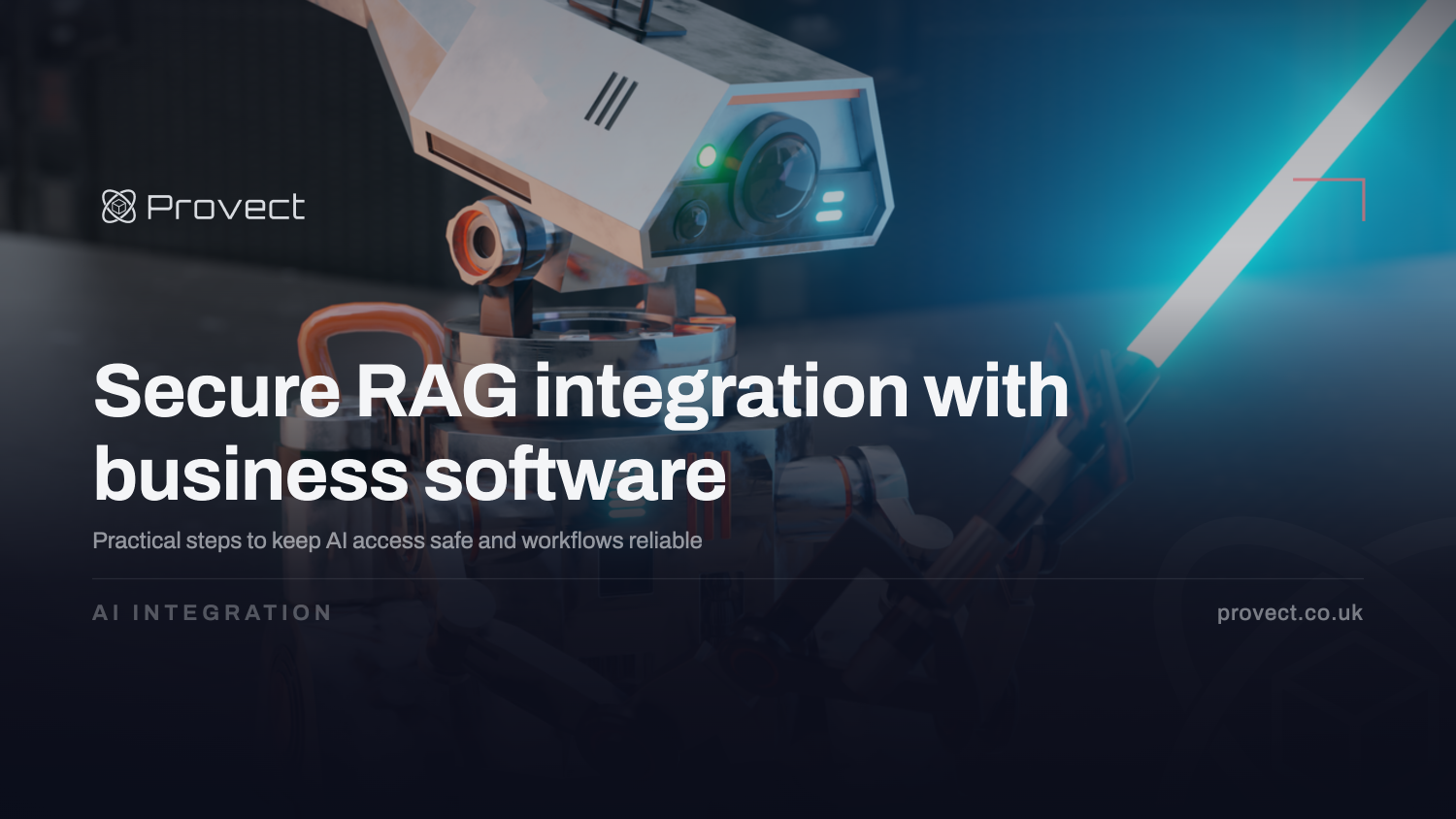
Integrating Retrieval-Augmented Generation (RAG) into your business software involves more than just connecting systems. It requires careful thought about data security, workflow design, and how AI interacts with people. Getting this wrong can expose sensitive information, deliver inaccurate results, or create confusion for users.
RAG is powerful because it combines AI with targeted search. It pulls information from your existing documents or databases to help with tasks like invoice processing, claims handling, or onboarding new staff. But that same access can turn risky if the AI sees too much or the connection isn’t secure. This guide breaks down the common pitfalls and how to avoid them.
#1. Too much data access creates risk and noise
A common mistake is giving RAG broad access to all company data. When the AI can search everything, it may surface irrelevant or confidential details. For example, if a system meant to handle invoices can also pull employee salaries or confidential contracts, it risks leaking sensitive information.
This is not just a privacy issue. It can also reduce the accuracy of the AI’s responses. The more unrelated data it sees, the harder it is for the system to pick out what really matters. The AI might mention irrelevant details or confuse one record with another.
The right approach is to scope access clearly. For an invoicing process, limit queries to invoice records only. For onboarding, restrict the AI to HR-approved documents and forms. This focused view keeps the AI relevant and lowers the chance of accidental exposure.
#2. Unsecured connections invite unauthorised access
Connecting RAG to your business software means opening a channel between systems. If this connection is not secure, it becomes a potential entry point for attackers or accidental leaks.
Using secure protocols such as HTTPS and enforcing strong authentication are essential. Most business software offers API access that requires keys or tokens. These credentials should be scoped to exactly what the AI needs, usually read-only, and limited to specific tasks.
Failing to secure these connections can mean anyone with access to the key can query your data. This risk grows if keys are shared too widely or stored insecurely.
#3. Leaving the AI unchecked leads to errors and mistrust
AI is not perfect. When RAG works alone without human oversight, there’s a risk of mistakes. For example, it might misinterpret ambiguous data or guess answers when it should say it doesn’t know.
In business workflows, errors can cause delays, incorrect invoices, or poor customer experiences. They also make users lose trust in the system.
Keeping a person in the loop is important. Design the process so the AI drafts suggestions or pulls information, but asks for confirmation when uncertain. This might mean flagging results below a confidence threshold or handing off complex cases for review.
#4. Ignoring changes in data and processes creates outdated access
Business data and processes are not static. Over time, new systems get added, roles change, and data itself evolves.
If you set up RAG access once and forget it, the AI might keep seeing data it shouldn’t or stop seeing new information it needs. This mismatch can lead to security gaps or reduce the tool’s usefulness.
A regular review cycle is necessary. Check the data sources RAG can query and update permissions as your systems and workflows change. This keeps access aligned with current business needs.
#5. Assuming AI replaces existing workflows completely
Some expect RAG to replace entire processes. In reality, the best results come when AI fits into workflows you already understand and trust.
For example, rather than rewriting a whole invoicing system, use RAG to speed up specific tasks like pulling invoice details or suggesting next steps. This reduces risk and helps users adopt the tool more easily.
#What to do first
Start by mapping where your key data lives and who needs to see it. Understand the exact information your AI-assisted process needs and no more. Next, set up secure, scoped connections with proper authentication.
Plan in the human hand-off points where the AI should defer to a person. Finally, schedule regular reviews of data access and process changes.
Secure integration isn’t an add-on. It’s the foundation for trustworthy AI.
Many integrations fail because they ignore the evolving nature of data or treat RAG like a black box to throw tasks at. Taking control of data access, connection security, and human oversight makes RAG a tool you can rely on, not a risk you have to manage.
Recognise any of this in your own business? Tell us about it and we’ll say whether it’s worth automating.
Talk through your process